Put the kettle on, put your feet up, and enjoy a twisty-turny (and still unsolved) detective story which spans the centuries. Thanks to the Harris Museum and Art Gallery in Preston, we give you the story of the Rossall Hoard. (Photos in this article are all with thanks to the Harris Museum, Preston).
What is the Rossall Hoard?
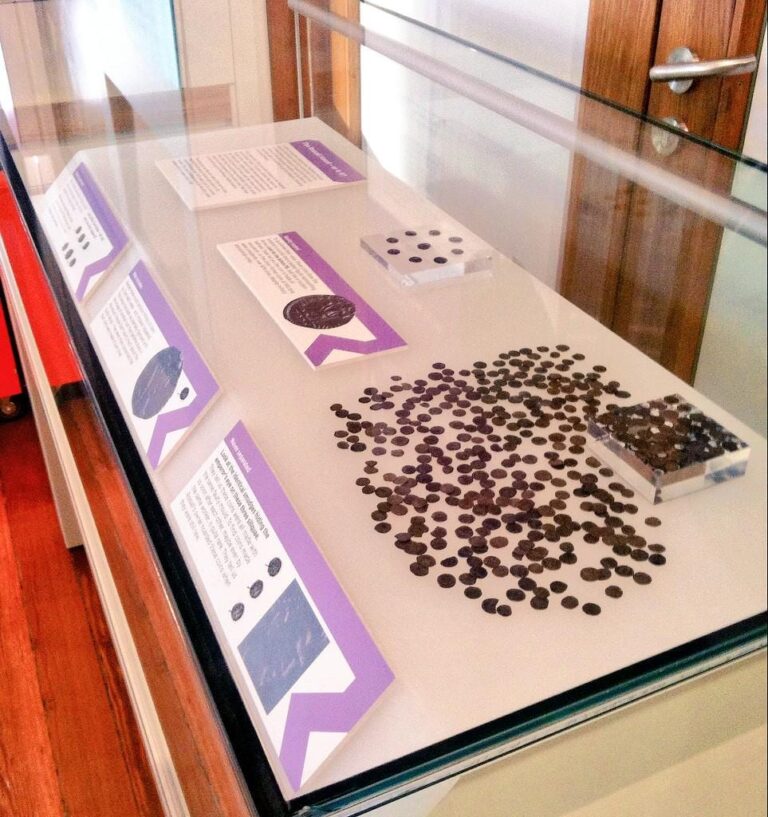
The Rossall Hoard is a large group of 388 late Roman silver siliquae. Originally minted at locations around France, Germany and Italy between c.355-402 AD.
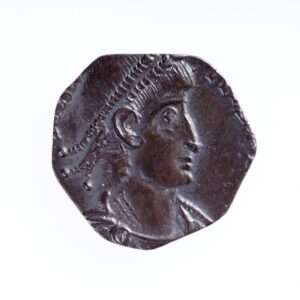
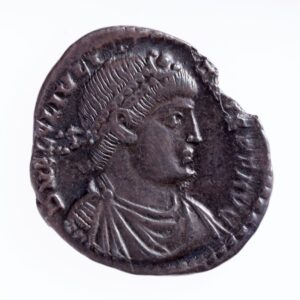
- In chronological order, this is the first emperor to appear on coins from the Rossall Hoard. It’s Constantius II, on a coin from c.355-360 AD

- This is Constantius II successor, Julian II, on a coin from 363 AD
- Followed by the emperor Valens, on a coin from 374-377 AD
- The next coin, featuring emperor Honorius, dates from the tail end of the hoard. Honorius was the last emperor whose coins made their way to Britain before Rome’s withdrawal. It dates from 397-402 AD.
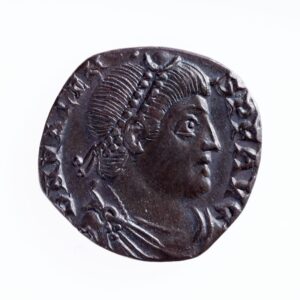
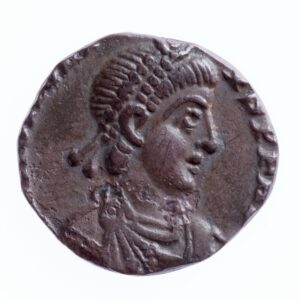
This is amongst the last wave of coins to be supplied to Britain before the collapse of Roman administration, around 410. The usurper Constantine III withdrew what remained of the Roman army in Britain away to the continent in order to fight Honorius, the legitimate emperor.
And here the story twists and turns…
It’s what you could call the ‘Rossall Hoard mystery’.
The coins held at the Harris Museum, bequeathed to by the wealthy Brown family of Preston in the 1880s, don’t seem to be the authentic Rossall Hoard. That was found near Fleetwood in 1840.
It seems that the ‘real’ hoard disappeared into history in the wake of the bankruptcy of their first owner, Sir Peter Fleetwood-Hesketh, in 1844. The Harris is trying to track down the original hoard – do you know any helpful information?
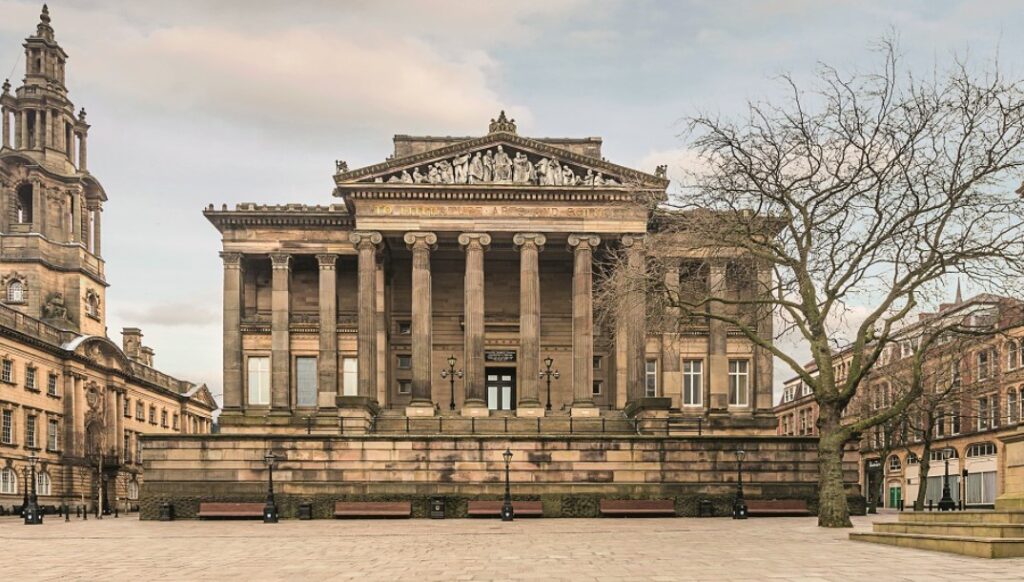
The originals weren’t actually, well, original….
To confuse matters even more, the ‘real’ Rossall Hoard wasn’t a late Roman coin hoard at all. It included 400 silver denarii from the first to third century, ie totally different coins!
FREE Newsletter
FREE Newsletter

The Rossall Hoard was kept at Rossall Hall, alongside the rest of Sir Peter Fleetwood-Heskeths coin, medal and cameo collection. In 1844 Rossall Hall and its contents were sold. Unfortunately, the auctioneer mistakenly sold the fourth-fifth century AD hoard (which the Harris had on display) for the real Rossall Hoard.
In 1883, Dr. Charles Brown (son of the man who purchased the hoard at the sale in 1844) donated the coins to the museum in Preston. Only then did someone notice the donation was composed of fourth-fifth century coins. Not first-third century ones, as it was expected to! (are you keeping up so far?)
Where did the ‘real’ Rossall Hoard go?
It’s anyone’s guess where the genuine Rossall Hoard ended up in the intervening years between 1844 and 1883.
There are a number of possibilities:
- the auctioneer could have broken it up to sell in individual packets,
- or it could have been kept by the family. But they don’t seem to recall this ever having happened.
No one really knows where the fourth-fifth century hoard of siliquae came from. Sir Peter, or one of his family members, must have picked them up – perhaps at a sale. It’s very unlikely to have come from Lancashire, though. Hoards of this date and composition are normally found in the southern counties of England. It is British, though – coin clipping was a particularly British phenomenon.
The family have no archives relating to the purchase of anything matching this description, making the detective work even trickier.
Rough Guide to the Rossall Hoard
If you lost that somewhere in the middle, in summary:
1. A hoard of Roman coins from 70-c.200 AD was found by brick workers in the ground near Fleetwood.
2. They went into the ownership of Sir Peter Fleetwood-Hesketh at nearby Rossall Hall. They became known as the Rossall Hoard.
3. In 1844 he went bankrupt, sold the hall, and all its contents. Including his large coin collection. The Rossall Hoard formed but one part of it.
4. The auctioneer mistakenly identified the current hoard of Roman coins from c.355-402 AD as the Rossall Hoard. With no surviving paperwork, family documents, or auction records we cannot know for definite where this hoard came from, or when the Fleetwood-Heskeths acquired it.
5. Alderman Brown of Preston bought them at the auction. He had no reason to think they were anything other than the genuine Rossall Hoard, found in 1840.
6. Upon his death he passed them on to his son, Dr. Charles Brown.
7. Dr. Brown donated them to the museum in Preston (then at Cross Street) in 1883.
8. 1887 is the first recorded mention of somebody noticing that the dates of the coins didn’t match up to the original reports from 1840. So these old coins couldn’t be the same Rossall Hoard that everybody believed them to be!
Rossall Hoard Exhibition
The Rossall Hoard was on display at the Harris Museum at the end of 2014 and into 2015.
The entire hoard was photographed, catalogued, and prepared for display. The then exhibition covered several of its most interesting aspects.

Coin clipping. Like most hoards of its date, Rossall has been extensively attacked by coin clippers. They snipped silver from the coins to produce imitations. These counterfeit coins looked and felt exactly like the official coins the Roman state supplied before the end of Roman control.
In this respect the Rossall coins straddle two worlds – the Roman and the post-Roman. They show how people tried to continue supplying themselves with ‘Roman style’ coins even after they ceased to be part of the empire.
Mint mistakes and die-links. Particular mis-struck and die-linked coins shed light on the way Roman coins were produced in the later empire. Minted in astonishing numbers, the die-linked coins were coins made using the very same mould.
Matt, the project curator, sent the photos of the display used in this article.
While you’re here…
Have a look at the homepage of the Visit Fleetwood website for more of the latest updates.
Love the Fylde Coast? Sign up for your weekly email newsletter. Packed full of interesting things it arrives in your inbox all 52 weeks of the year.
Join us on Facebook at our Visit Fylde Coast Facebook Group
Don’t forget to follow us on Twitter @visitFyldeCoast

We Need Your Help
We Need Your Help